
Concrete Driveway Crack Repair Services in Sacramento, CA

Why Sacramento Homeowners Call Us for Driveway Crack Repair
- Certified crack repair technicians trained in both structural and non-structural repair methods
- Free on-site inspection with a written damage assessment before any work is quoted
- Flat-rate transparent pricing with no surprise charges after the job is done
- Material matched to crack-type epoxy for structural, polyurethane for active, color-matched filler for stamped surfaces
- Same-day emergency response when a cracked driveway becomes a safety hazard
- Written warranty on all repair work and materials
- California building code compliant work on every project
- Residential and commercial experience from single driveways to multi-unit parking areas
- Clean job sites and crews that show up on time and leave the site the way they found it
Our Concrete Driveway Crack Repair Services
Concrete Driveway Epoxy and Polyurethane
Crack Repair
The material you pick for a crack repair matters more than most homeowners realize. Epoxy and polyurethane are both used for concrete cracks, but they do opposite jobs. Epoxy is rigid. It bonds the two crack faces together permanently and restores the original tensile strength of the slab across the crack. Polyurethane is flexible. It seals the crack watertight and moves with the slab when Sacramento's clay soil shifts beneath it. Using epoxy on an active crack locks in movement the slab needs to make, and the repair fails at the bond line in one season. We diagnose and repair both crack types across Carmichael, Fair Oaks, East Sacramento, Midtown Sacramento, and Natomas.
We inject the repair material using a dual-port injection system with a 0 to 100 psi digital pressure gauge . Two injection ports are set along the crack, one at the entry point and one further along. The gauge monitors pressure at both ports simultaneously. When the reading at the exit port matches the entry port, we know the resin has traveled the full depth and width of the crack with no unfilled voids. For stable structural cracks, we inject Emecole 500 Premium two-component rigid epoxy resin , rated to ASTM C881 Type I Grade 1 standards , with a tensile strength of 8,500 psi at 7 days. For active moving cracks, we inject Sikaflex-1a one-component polyurethane sealant, rated to ASTM C920 Type S Grade NS Class 25 with an elongation at break of 600%, giving it the flexibility to stretch and compress with seasonal slab movement.
All epoxy injection work follows ACI 503.7-07 , the American Concrete Institute's specification for crack repair by epoxy injection. This standard governs injection port spacing, working pressure limits, and curing verification before the ports are removed.
Stamped Concrete Driveway Crack Sealing
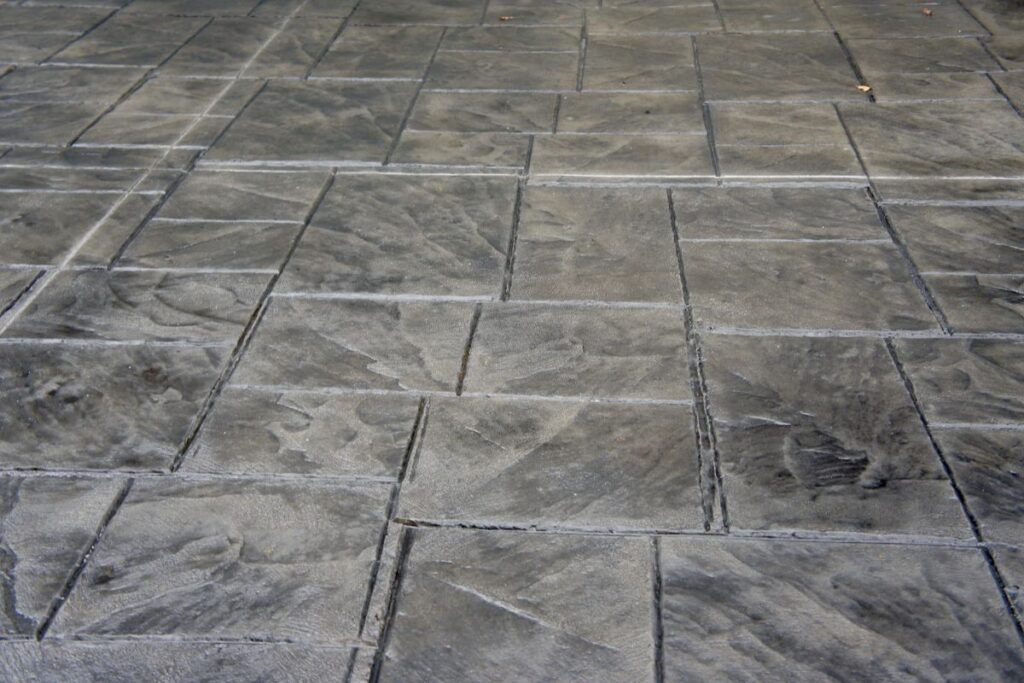
A crack through a stamped concrete driveway is not the same problem as a crack through a plain gray slab. The cost of the original stamped installation, which can reach $15,000 or more for a full driveway, makes the repair far more visible and far more consequential. A standard gray filler packed into a crack running through a cobblestone or ashlar pattern creates a permanent visible scar across the decorative surface. We specialize in crack sealing on stamped driveways across Folsom, Land Park, Carmichael, East Sacramento, and Natomas, where decorative concrete driveways are common.
The first step is routing the crack to a consistent width. We use a crack groove router with a 1/4 inch bit to open the crack to a precise and uniform channel. An irregular crack edge produces uneven filler depth. Uneven filler depth is visible through the decorative texture because light catches the surface differently at thin and thick sections. After routing, we fill the crack with Rapid Set TRUFlex elastomeric crack filler tinted with Davis Colors iron oxide pigments matched to the original stamped surface color. Davis Colors' iron oxide pigments are the industry standard for replicating Sacramento-area stamped concrete installations because they do not fade under Sacramento's UV load and do not shift color as they cure.
Crack repair on decorative concrete surfaces follows the material selection and application protocols in ACI 310R-13, the American Concrete Institute's guide to decorative concrete. This document addresses how to select fillers and overlay materials for textured surfaces where visual match is a primary performance requirement alongside structural sealing.
Driveway Concrete Structural Load Crack Rehabilitation
A crack that flexes when you drive over it is not a surface problem. It is a structural failure. When a slab deflects under wheel load, the crack is running full depth through the concrete. Both sides of the crack are moving independently. Filling that crack with any filler material, epoxy or polyurethane, will not stop the movement. The filler will re-crack at the bond line, sometimes within days. The correct solution restores load transfer across the crack using physical fastening. We perform structural crack rehabilitation across Rancho Cordova, West Sacramento, South Sacramento, Downtown Sacramento, and Citrus Heights.
First, we drill perpendicular channels across the crack for the dowel bar system. We use a 1/2 inch diamond core drill bit in an SDS-plus rotary hammer to bore channels 4 inches deep on each side of the crack at 12-inch intervals along the fracture. Diamond core bits are required because the hardened concrete in Sacramento residential driveways minimum 3,000 psi compressive strength, which will deflect a standard masonry bit off course. Into each channel, we set a Simpson Strong-Tie DSSB2 dowel bar using Simpson ET anchoring adhesive rated to ASTM C881 Type IV Grade 3 standards . The dowel bars restore vertical load transfer across the crack, so each slab panel carries wheel loads as a unit instead of independently. For cracks showing lateral spreading in addition to vertical deflection, we epoxy-bond Sika CarboDur S512 carbon fiber reinforced polymer strips transversely across the crack at 12-inch intervals. Each strip measures 2 inches wide and 0.047 inches thick with a tensile strength of 3,625 ksi, more than enough to prevent further lateral crack widening under vehicle load.
Carbon fiber reinforced polymer strengthening of concrete flatwork follows ACI 440.7R-10 , the American Concrete Institute's guide for the design and construction of externally bonded FRP systems for strengthening concrete. This standard governs surface preparation, epoxy primer selection, CFRP strip installation, and cure verification before the rehabilitated slab returns to service.
Concrete Driveway Resurfacing for Extensive
Crack Damage
At some point, a driveway has too many cracks to fill individually. When cracks appear every 4 square feet or closer, or when the crack pattern forms a web across the whole surface, individual crack filling costs more and lasts less than a full surface overlay. Resurfacing places a new concrete layer directly over the existing slab. The old cracks are bridged and locked below the overlay. The surface above is fresh, clean, and rated for full vehicle traffic. We resurface crack-damaged driveways across Citrus Heights, Arden-Arcade, South Sacramento, East Sacramento, and Carmichael.
We spread the overlay using a gauge rake with a 1/8 inch pin setting . The pins sit on the existing slab surface and hold the rake head at a fixed height of 1/8 inch above the slab as it travels across the driveway. This maintains a consistent overlay thickness from the garage apron to the street. A uniform overlay thickness is important because thin sections cure faster and can crack under thermal load before the rest of the overlay sets. We apply Ardex K 520 polymer-modified cementitious resurfacing system as the overlay material. This product applies from a feather edge up to 1/4 inch thick in a single pass, meets ASTM C109 compressive strength standards , and reaches 5,000 psi at 28 days. It bonds to the existing concrete base and holds up under full vehicular traffic.
Bonded concrete overlay systems applied over cracked driveways follow ACI 548.13R-14 , the American Concrete Institute's guide to concrete overlays. This standard covers the minimum substrate compressive strength, surface preparation profile, and bond testing requirements that must be met before a bonded overlay can be installed as a permanent repair.
Concrete Driveway Thermal Expansion
Crack Repair
Some driveways develop a new straight crack every summer. The crack appears in June when temperatures climb. It partially closes in winter and then reopens a little wider the following summer. This is not random damage. It is thermal expansion. When a concrete slab gets hot, it expands. If there is no expansion joint nearby to absorb that growth, the slab creates its own relief point by cracking at the weakest panel location. We repair thermal expansion cracks across Natomas, Elk Grove, Folsom, Rancho Cordova, and Roseville.
Before we apply any sealant, we route the thermal crack to a controlled shape. We use a rotary crack router with a 3/4 inch carbide bit to cut a uniform reservoir along the crack line. The router produces a slot that is 3/4 inch wide and 3/8 inch deep. This shape seats the backer rod at the correct depth and creates the hourglass profile the sealant needs to flex without tearing. We seal all routed thermal cracks with Crafco Superseal 125 hot-applied joint sealant , rated to ASTM D6690 Type II standards. This product is specifically formulated for thermal movement in concrete flatwork. It has a movement accommodation factor of plus or minus 50%, meaning it can stretch or compress by half its installed width without losing adhesion to the crack walls, more than enough to handle Sacramento's full summer-to-winter temperature range.
Expansion joint placement and sealant requirements for concrete flatwork in Sacramento follow City of Sacramento Standard Construction Specifications Section 41-2.05 , which governs joint spacing and sealant performance for new and repaired concrete flatwork adjacent to public infrastructure.
Concrete Driveway Emergency Crack Repair and Same-Day Service
Some crack damage cannot wait. A driveway crack that doubles in width after a heavy rain leaves a raised lip that can catch a vehicle bumper or create a trip hazard at the garage entry. A crack that opens into a channel directs runoff straight toward your foundation. In Sacramento, November and December storms can turn a stable small crack into a drainage emergency in hours. Also, if your driveway fronts a public sidewalk and a raised crack edge meets the ADA definition of a trip hazard, your property carries liability until the hazard is corrected. We respond to emergency crack repair calls across all of Sacramento, including Natomas, Rancho Cordova, Downtown Sacramento, Elk Grove, and South Sacramento.
On every emergency call, we arrive with pre-measured mixed water and pre-weighed material so the batch goes down within minutes of arrival. We mix the patch material using a variable-speed mixing paddle drill set to 400 rpm to hit the exact water-to-cement ratio the manufacturer specifies. Mixing too fast introduces air bubbles that weaken the patch. Mixing too slowly leaves dry pockets that reduce compressive strength. The patch material we use for emergency repairs is CTS Rapid Set Cement All, which meets ASTM C928 R1 standards, reaches 3,000 psi in 15 minutes, and is ready for vehicle traffic in 60 minutes after placement. This timeline means most emergency repairs are ready for normal driveway use before we leave the site.
Under California Civil Code Section 1714, property owners owe a duty of care to anyone who uses or passes by their property. A concrete crack that creates a raised edge or an open hazard on a driveway accessible to the public falls within that duty. We mark the work zone with traffic cones and barrier tape on every emergency repair until the patch has reached safe walking strength.
Our Repair Process

On-Site Assessment and Crack Diagnosis
We visit your property, inspect the full driveway, measure and map all cracks, and check for any movement under pressure to identify the type and severity of damage. You’ll receive a detailed written summary with our findings and recommended repairs for each area.
Matched Repair Plan and Written Quote
We match each crack or crack zone to the correct repair method. We put the full scope in writing, including material, method, cure time, and price, before any work begins. No work starts without your approval.

Repair, Cure, and Final Inspection
We complete the repair using the material and method specified for each crack type. After cure, we walk the full driveway with you and confirm every repaired section is level, sealed, and ready for traffic. We do not close the job until you are satisfied with the result.